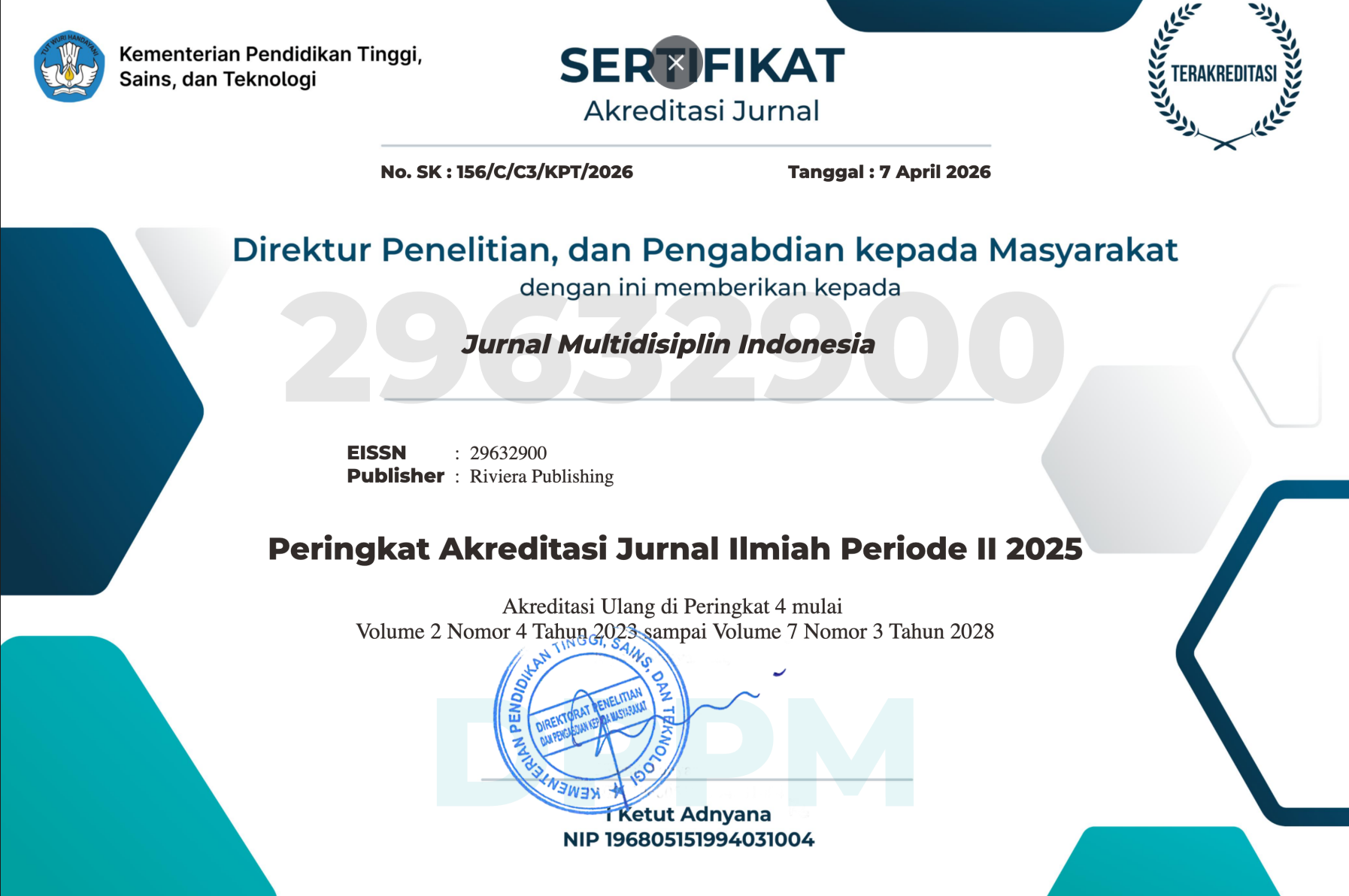
The Influence of Nurse Knowledge and Clinical Leadership on Patient Safety Incident Reporting with Patient Safety Culture as a Mediation Variable at Abdi Waluyo Hospital
Downloads
Patient safety incident reporting is essential for identifying potential risks, preventing adverse events, and improving the quality of hospital care. At Abdi Waluyo Hospital, limitations in nurses' understanding of incident reporting procedures and access to feedback have presented challenges to effective patient safety management. This study examined the relationships between nurses' knowledge, clinical leadership, and patient safety incident reporting, with patient safety culture serving as a mediating variable. A quantitative cross-sectional study was conducted from May to June 2026, involving 150 nurses providing direct patient care at Abdi Waluyo Hospital in Central Jakarta, Indonesia. Participants were recruited using total population sampling, and data were collected through a structured questionnaire employing a four-point Likert scale. Data were analyzed using the Three-Box Method for descriptive analysis and partial least squares structural equation modeling (PLS-SEM) with SmartPLS 4. The findings revealed that nurses' knowledge and clinical leadership were positively and significantly associated with both patient safety culture and incident reporting. Patient safety culture demonstrated the strongest direct association with incident reporting (? = 0.511, p < 0.001) and partially mediated the relationships between nurses' knowledge, clinical leadership, and incident reporting. The structural model explained 48.5% of the variance in patient safety incident reporting. Descriptive findings indicated that incident reporting had the lowest index among the four constructs, with feedback provision representing its lowest-scoring indicator. The study concluded that strengthening nurses' knowledge, promoting participatory clinical leadership, and fostering a supportive patient safety culture could improve incident reporting practices. Hospitals should prioritize continuous training, nurse involvement in safety-related decisions, and consistent feedback mechanisms to promote transparent reporting and organizational learning.
Agency for Healthcare Research and Quality. (2024). Surveys on Patient Safety Culture (SOPS) Hospital Survey 2.0: User database report (AHRQ Publication No. 25-0006). Agency for Healthcare Research and Quality.
Al-Oweidat, I. A., Saleh, A., Khalifeh, A. H., Abu Tabar, N., Al Said, M. R., Khalil, M. M., & Khrais, H. (2023). Nurses’ perceptions of the influence of leadership behaviours and organisational culture on patient safety incident reporting practices. Nursing Management, 30(6), 33–41. https://doi.org/10.7748/nm.2023.e2088
Alsobou, N., Rayan, A. H., Baqeas, M. H., ALBashtawy, M. S., Oweidat, I. A., Al-Mugheed, K., & Abdelaliem, S. M. F. (2025). The relationship between patient safety culture and attitudes toward incident reporting among registered nurses. BMC Health Services Research, 25, Article 612. https://doi.org/10.1186/s12913-025-12763-0
Argyris, C., & Schön, D. A. (1978). Organizational learning: A theory of action perspective. Addison-Wesley.
Bandura, A. (1986). Social foundations of thought and action: A social cognitive theory. Prentice-Hall.
Bass, B. M., & Avolio, B. J. (2004). Multifactor leadership questionnaire: Manual (3rd ed.). Mind Garden.
Carper, B. A. (1978). Fundamental patterns of knowing in nursing. Advances in Nursing Science, 1(1), 13–23. https://doi.org/10.1097/00012272-197810000-00004
Edmondson, A. (1999). Psychological safety and learning behavior in work teams. Administrative Science Quarterly, 44(2), 350–383. https://doi.org/10.2307/2666999
Elmi, A. H., Hassan, R. A., Abdi, A. O., Yusuf, F. Y., HassanIbrahim, K., & Abdi, A. A. (2025). Awareness of reporting practices and barriers to incident reporting among nurses in Mogadishu, Somalia. BMC Nursing, 24, Article 1134. https://doi.org/10.1186/s12912-025-03799-y
El-Sayed, B. K. M., Mohmed, E. A. T., Baddar, F. M., & Khattab, S. M. K. (2025). Insights from critical care nurses: Role of leadership coaching in enhancing incident reporting culture: A cross-sectional study. BMC Nursing, 24, Article 1156. https://doi.org/10.1186/s12912-025-03791-6
Fekadu, G., Tobiano, G., Muir, R., Engidaw, M. T., & Marshall, A. P. (2025). Factors influencing patient safety incident reporting in African healthcare organisations: A systematic integrative review. BMC Health Services Research, 25, Article 619. https://doi.org/10.1186/s12913-025-12762-1
Gad, I. I. M., Abdelwahab, E. A., Zarif, B., & Khalil, N. E. M. (2025). Staff nurses’ awareness, compliance, and barriers regarding incident reporting in a government health organization. Egyptian Nursing Journal, 22(2), 163–175. https://doi.org/10.4103/enj.enj_17_25
Hamed, M. M. M., & Konstantinidis, S. (2022). Barriers to incident reporting among nurses: a qualitative systematic review. Western Journal of Nursing Research, 44(5), 506–523.
Han, N., Jeong, S. H., Lee, M. H., & Kim, H. S. (2024). Impacts of just culture on perioperative nurses’ attitudes and behaviors with regard to patient safety incident reporting: Cross-sectional nationwide survey. Asian Nursing Research, 18(4), 323–330. https://doi.org/10.1016/j.anr.2024.09.001
Institute of Medicine. (2000). To err is human: Building a safer health system. National Academies Press. https://doi.org/10.17226/9728
Karmila, K., Suharni, S., & Alwi, M. K. (2023). Hubungan budaya keselamatan pasien dengan pelaporan insiden keselamatan pasien oleh perawat di Instalasi Rawat Inap Rumah Sakit TK II Pelamonia Makassar. Journal of Muslim Community Health, 4(1), 181–189.
Kementerian Kesehatan Republik Indonesia. (2017). Peraturan Menteri Kesehatan Republik Indonesia Nomor 11 Tahun 2017 tentang Keselamatan Pasien. Kementerian Kesehatan Republik Indonesia.
Ko, E. S., & Kang, K. J. (2023). Effects of nurses’ incident reporting attitude, perception of importance on patient safety management, and patient safety culture on the reporting of patient safety events. Journal of Korean Academy of Nursing Administration, 29(3), 309–319.
Moon, J. Y., Welp, C., Nold, M., Nienow, J., Rader, T., Ramar, K., & Cowart, J. B. (2026). Optimizing event reporting to drive a culture of learning and safety: A system-based approach to mitigating harm through near-miss and no-harm reporting. Journal of Patient Safety, 22(1), 86–92. https://doi.org/10.1097/PTS.0000000000001424
National Health Service. (2021). National patient safety incident reports. NHS England.
NHS Leadership Academy. (2011). Clinical leadership competency framework. NHS Institute for Innovation and Improvement.
Pamela, C. A., Ahsan, A., & Wardhani, V. (2025). Relationship between head nurses’ transformational leadership style and attitudes toward reporting patient safety incidents in hospitals. Jurnal Ners dan Kebidanan Indonesia, 13(2), 213–225. https://doi.org/10.21927/jnki.2025.13(2).213-225
Pemerintah Republik Indonesia. (2024). Peraturan Pemerintah Nomor 28 Tahun 2024 tentang Peraturan Pelaksanaan Undang-Undang Nomor 17 Tahun 2023 tentang Kesehatan.
Pronovost, P. J., Holzmueller, C. G., Young, J., Whitney, P., Wu, A. W., Thompson, D. A., Lubomski, L. H., & Morlock, L. L. (2007). Using incident reporting to improve patient safety: A conceptual model. Journal of Patient Safety, 3(1), 27–33. https://doi.org/10.1097/pts.0b013e318030ca05
Reason, J. (1997). Managing the risks of organizational accidents. Ashgate.
Reason, J. (2000). Human error: Models and management. BMJ, 320(7237), 768–770. https://doi.org/10.1136/bmj.320.7237.768
Smit, C., & Peddle, M. (2025). Experiences and perceptions of registered nurses who work in acute care regarding incident reporting: A scoping review. Healthcare, 13(11), Article 1250. https://doi.org/10.3390/healthcare13111250
Tresfon, J., van Winsen, R., Brunsveld-Reinders, A. H., Hamming, J., & Langeveld, K. (2025). Hospital ward incidents through the eyes of nurses – A thick description on the appeal and deadlock of incident reporting systems. Safety Science, 184, Article 106728. https://doi.org/10.1016/j.ssci.2024.106728
Winata, S. A. P., & Paramarta, V. (2025). Strategi implementasi patient safety di rumah sakit: Kajian literatur untuk peningkatan mutu layanan. Jurnal Manajemen Aset Infrastruktur & Fasilitas, 9(2), 101.
World Health Organization. (2019). Patient safety: Global action on patient safety. World Health Organization.
World Health Organization. (2021). Global patient safety action plan 2021–2030: Towards eliminating avoidable harm in health care. World Health Organization.
Copyright (c) 2026 Vika Zakkiya Robbani, Aprilita Rina Yanti, Erry Yudhya Mulyani

This work is licensed under a Creative Commons Attribution-ShareAlike 4.0 International License.