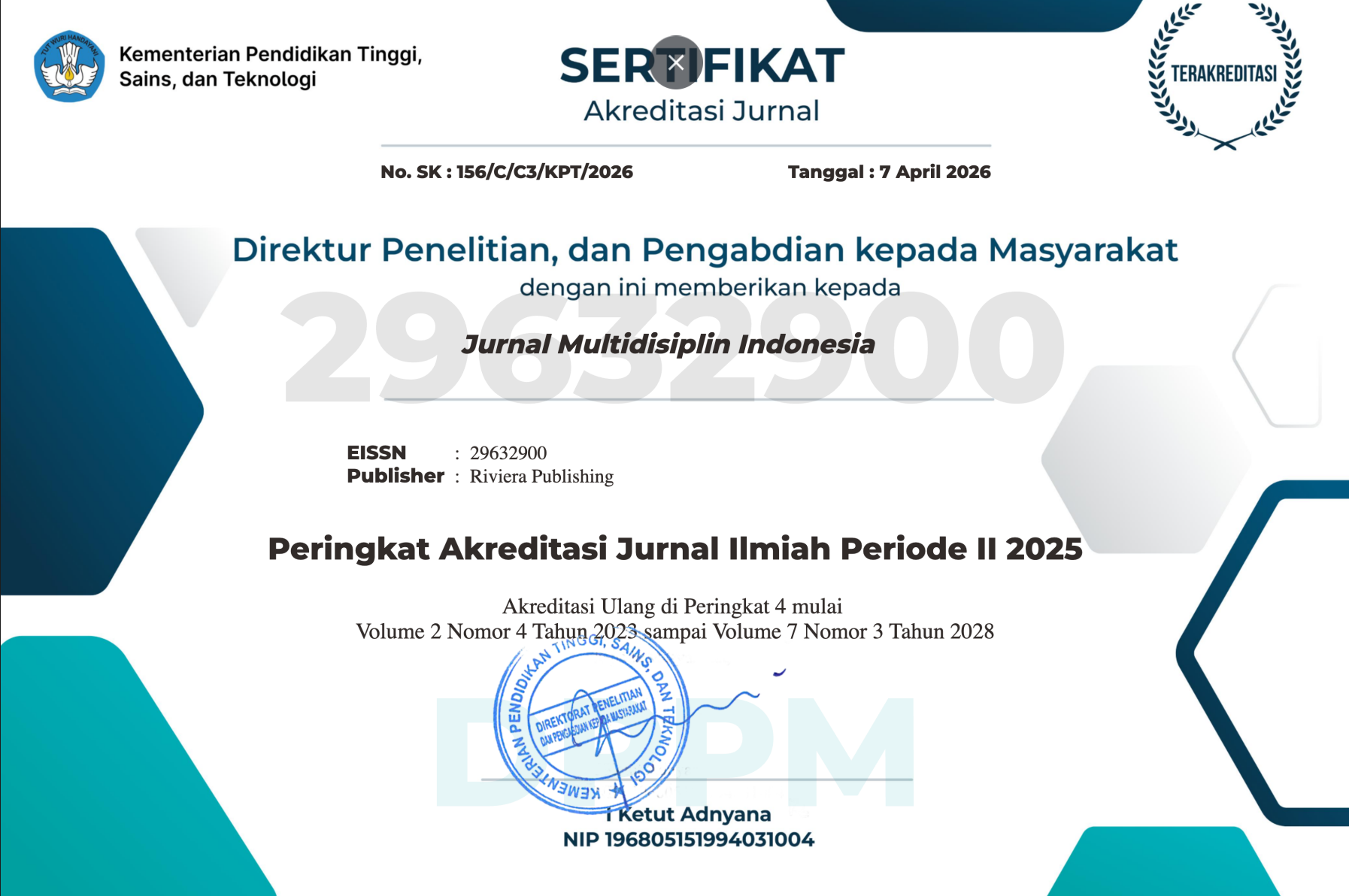
Faktor-Faktor Budaya Kerja yang Mempengaruhi Kinerja Karyawan di Perguruan Tinggi: Studi Kasus Pada Perguruan Tinggi Swasta di Tangerang Selatan, Indonesia
Downloads
aya kerja merupakan salah satu faktor strategis yang menentukan keberhasilan organisasi, termasuk pada institusi pendidikan tinggi yang menghadapi tuntutan peningkatan kualitas sumber daya manusia secara berkelanjutan. Perguruan tinggi swasta (PTS) memiliki tantangan khusus dalam membangun lingkungan kerja yang mampu meningkatkan motivasi, keterlibatan, dan kinerja karyawan. Penelitian ini bertujuan untuk menguji pengaruh faktor-faktor budaya kerja yang meliputi budaya penghargaan dan kompensasi, budaya pelatihan dan pengembangan, budaya kepemimpinan, serta budaya manajemen konflik terhadap kinerja karyawan pada perguruan tinggi swasta di Tangerang Selatan, Indonesia. Penelitian ini menggunakan pendekatan kuantitatif dengan desain explanatory research. Data dikumpulkan melalui penyebaran kuesioner menggunakan skala Likert kepada 64 responden yang terdiri atas dosen dan tenaga kependidikan. Analisis data dilakukan menggunakan Structural Equation Modeling (SEM) untuk menguji hubungan antarvariabel penelitian. Hasil penelitian menunjukkan bahwa budaya kepemimpinan dan budaya manajemen konflik berpengaruh positif dan signifikan terhadap kinerja karyawan. Budaya manajemen konflik menjadi faktor yang paling dominan dalam meningkatkan kinerja karyawan, sedangkan budaya penghargaan dan kompensasi serta pelatihan dan pengembangan tidak menunjukkan pengaruh signifikan. Temuan ini menunjukkan bahwa penciptaan lingkungan kerja yang kondusif melalui kepemimpinan yang efektif, komunikasi yang baik, serta mekanisme penyelesaian konflik yang jelas menjadi faktor penting dalam meningkatkan kinerja karyawan PTS. Penelitian ini memberikan implikasi bagi pengelola perguruan tinggi untuk memperkuat budaya organisasi sebagai strategi peningkatan produktivitas dan keberlanjutan institusi.
Abawa, A., & Obse, H. (2024). Organizational culture and organizational performance: does job satisfaction mediate the relationship? Cogent Business & Management, 11(1), 2324127.
Amel, E. L., Manning, C. M., Daus, C. S., & Quinn, M. (2024). Organizational culture. Fostering Sustainability in Higher Education, 15–33
Ampong, I. (2024). Assessing the effect of employee welfare andcompensation on organizational performance: A case of Sahel Sahara Bank Ghana limited. Cogent Business & Management, 11(1), 1–1. https://doi.org/10.1080/2331 1975.2024.2315690
Asamoah, D., Shahrill, M., & Abdul Latif, S. N. (2024). Teachers’ perceptions of school assessment climate and realities of assessment practices in two educational contexts. Frontiers in Education, 9, 1278187. https://doi.org/10.3389/ feduc.2024.1278187
Batool, S., Ibrahim, H. I., & Adeel, A. (2024). How responsible leadership pays off: Role of organizational identification and organizational culture for creative idea sharing. Sustainable Technology and Entrepreneurship, 3(2), 100057. https://doi.org/10.1016/j.stae.2023.100057
Benedicta S. L. dan Samuel Y. A., 2025, Person-centred analysis on the influence of organizational culture on employee job performance, Cogent Social Sciences 2025, VOL. 11, NO. 1, 2526008
Cheng, J. Y.-J., & Groysberg, B. (2020). How corporate cultures differ dround the world. Harvard Business Review, 8, 8-11. https://www.hbs.edu/faculty/Pages/item.aspx?num=57732
Dabale, W. P., Jagero, N., & Nyauchi, M. (2014). The relationship between training and employee performance: The case of Mutare City council, Zimbabwe. International Journal of Human Resource Studies, 4(4), 61. https://doi. org/10.5296/ijhrs.v4i4.6620
Fakhar, S., Iqbal, I., & Gulzar, M. (2014). Impact of organizational culture on. Employees job performance: An empirical study of software houses in Pakistan. Journal of Business Studies Quarterly, 5(2), 56–64
Garengo, P., & Betto, F. (2024). The role of organisational culture and leadership style in performance measurement and management: A longitudinal case study. Production Planning & Control, 35(2), 151–169. https://doi.org/10.1080/ 09537287.2022.2058431
Gerson, G., Sangapan, L. H., Sangapan, A. H. Manurung (2025). Pengaruh Strategi Pelatihan dan Pengembangan Terhadap Kinerja Relasional Karyawan, Vol 1, No.2, Jurnal Strategis dan Sumber Daya Manusia
Haffar, M., Al-Karaghouli, W., Djebarni, R., Al-Hyari, K., Gbadamosi, G., Oster, F., Alaya, A., & Ahmed, A. (2023). Organizational culture and affective commitment to e-learning’ changes during COVID-19 pandemic: The underlying effects of readiness for change. Journal of Business Research, 155(PA), 113396. https://doi.org/10.1016/j.jbusres. 2022.113396
Hafeez, U., & Akbar, W. (2015). Impact of training on employees performance. (Evidence from pharmaceutical companies in Karachi. Pakistan). Business Management and Strategy, 6(1), 49–64. https://doi.org/10.5296/bms.v6i1.7804
Lee, K. J., & Choi, S. Y. (2023). Resourceful and demanding attributes of organisational culture, employee satisfaction, and organisational performance of large R&D intensive firms in the US, 1–14. Technology Analysis & Strategic Management
Lee, J. Y., Kim, S., Noh, S., Jang, S. H., & Lee, S. Y. (2024). Paradoxical organizational culture, authoritarian leadership, and international firm performance: Evidence from international firms in China. Journal of International Management, 30(1), 101117. https://doi.org/10.1016/j.intman.2023.101117
Mensah, J. E. (2019). Impact of organizational culture on organizational performance at CAL Bank, Takoradi branch (Doctoral dissertation, University of Cape Coast)
Nafi’ah, Faridhatun dkk, 2025, Pengaruh Kompensasi Terhadap Kinerja Karyawan, Jurnal Riset Multidisiplin Edukasihttps://journal.hasbaedukasi.co.id/index.php/jurmie, Volume 2, Nomor 7, Bulan Juli, Halaman : 164-169
Nguyen, N. Y., Hang, T. T., Hiep, N., & Flynn, O. (2023). Does transformational leadership influence organisational culture and organizational performance: Empirical evidence from an. IIMB Management Review, 35(4), 382–392. https:// doi.org/10.1016/j.iimb.2023.10.001
Paais, M., & Pattiruhu, J. R. (2020). Effect of motivation, leadership, and organizational culture on satisfaction and employee performance. The Journal of Asian Finance, Economics and Business, 7(8), 577–588. https://doi.org/10.13106/ jafeb.2020.vol7.no8.577
Rabea Mansour, A., Mahmoud Hassan, R., & Mohamed Mohamed, F. (2023). Organizational culture and its influence on staff nurses empowerment. Egyptian Journal of Health Care, 14(4), 375–385. https://doi.org/10.21608/ ejhc.2023.326736
Sultana, A., Irum, S., Ahmed, K., & Mehmood, N. (2012). Impact of training on employee performance: A study of telecommunication sector in Pakistan. Interdisciplinary Journal of Contemporary Research in Business, 4(6), 646–661
Sa?nak, M., Ethical Leadership and Teachers’ Voice Behavior, 2017, The Mediating Roles of Ethical Culture and Psychological Safety, Educational Sciences: Theory & Practice, Vol. 17, Iss. 4, pp. 1101-17.
Silva, A. J., Burgette, A. R., & da Costa, J. F. (2024). Toward a sustainable world: Affective factors explain how emotional salary influences different performance indicators. Sustainability, 16(5), 2198. https://doi.org/10.3390/ su16052198
Tadesse Bogale, A., & Debela, K. L. (2024). Organizational culture: a systematic review. Cogent Business & Management, 11(1), 2340129. https://doi.org/10.1080/23311975.2024.2340129
Tedla, T. B. (2016). The impact of organizational culture on corporate performance [Doctoral dissertation]. Walden University
Theresia, L., dkk. 2018, The Influence of Culture, Job Satisfaction and Motivation on the Performance Lecturer / Employees, Proceedings of the International Conference on Industrial Engineering and Operations Management.
Theresia, L., & Bangun R., 2018, The Influence of Teacher Certificate, Job Satisfaction and Motivation on the Teacher's Performance, International Journal of Economic Research Volume 15 (Number 1):225-237.
Wisanggeni, D. H., Saputra, D. D., & Prasetio, T. (2024). Analisis kompensasi kerja terhadap peningkatan kinerja karyawan: Kajian literatur. Jurnal Publikasi Ilmu Manajemen, 3(4), 116–131. https://doi.org/10.55606/jupiman.v3i3.4630
Wi?niewska, M. Z., & Grudowski, P. (2024). The culture of excellence and its dimensions in higher education. The TQM Journal, 36(2), 593–615. https://doi.org/10.1108/TQM-11-2022-0325
Yuan, C.-K., & Lee, C.-Y. (2011). Exploration of a construct model linking leadership types, organization culture, employees performance and leadership performance. Procedia - Social and Behavioral Sciences, 25, 123–136. https:// doi.org/10.1016/j.sbspro.2011.10.534
Copyright (c) 2026 Linda Theresia, Annuridya R. P. O , Edward S. P. , Afina P. , Sarita Premana

This work is licensed under a Creative Commons Attribution-ShareAlike 4.0 International License.